
Company Criteria & Readiness Guide
What Medical Mondays is, how companies are considered, and what investors look for — a reference for founders preparing to pitch.
What Medical Mondays is
Medical Mondays is a virtual healthcare investor syndicate bringing together 80+ healthcare-focused angel groups, venture funds, hospital partners, and incubators across the country to evaluate early-stage healthcare, medtech, diagnostics, digital health, and therapeutics startups together. We fund both pediatric and adult healthcare innovations. It runs every Monday, 8:00–10:00 am PT. Each session features three vetted startups nominated by member groups.
The format per company is a 10-minute pitch, 10-minute investor Q&A, and a 10-minute internal investor-only debrief, followed by an interest poll; interested investors are then connected to collaborate on diligence. There is no cost to present or to participate.
10 min pitch · 10 min Q&A · 10 min investor debriefHow companies are considered
Companies are nominated by member groups or referral partners and onboarded (at no cost) through the coordinating SBDC (Small Business Development Center in Orange County CA or Austin TX). Onboarding is a short intake plus an SBDC sign-up; companies do not need to be located in Texas or California, though a brief out-of-area acknowledgment is requested if onboarding through the Austin SBDC without a local address. A pre-pitch readiness review is done before a company is scheduled.
Deal-structure requirements
These are structural and category-agnostic — they apply regardless of how strong the science or team is:
- Equity rounds: preferred stock only. Common-stock rounds are not considered.
- No pre-money SAFEs and no uncapped notes/SAFEs. Post-money SAFEs are acceptable but not preferred.
- Preferred structures: priced equity rounds and capped convertible notes.
- Only US companies can apply.
- Must be a C-Corporation. Required to issue preferred stock; LLCs and S-Corps don't qualify.
- A lead investor is strongly preferred, and expected for rounds above ~$3M.
- Round progress: on larger rounds (~$3–7M), roughly 20% of the round should already be committed; smaller rounds should generally have some capital closed and at least one group through diligence. Companies with nothing closed may be considered as an exception.
- Closing date must be at least 60 days after the Medical Mondays pitch date.
- Deal terms must be disclosed up front — include the current round terms (amount, instrument, and valuation/cap) in the deck.
Stage readiness by category
- Devices & diagnostics (implantable / surgical / monitoring / imaging / lab): prototype completed, at or near design freeze, with data demonstrating the solution is viable. Investors expect clinical or real-world outcomes evidence, not bench/biomechanical validation alone.
- Digital health: at minimum customer pilots; ideally paying customers.
- Biotech / therapeutics: past the pre-clinical stage, with a credible path to the clinic. New drug compounds are not considered — only repurposed drugs pursuing a 505(b)(2) pathway, or a novel method of delivering a drug, qualify. (A new drug may be considered only as an exception: a very strong investor champion and existing human data.)
- Tools / infrastructure: beyond prototype, similar bar to digital health.
What investors look for in the pitch
A strong Medical Mondays pitch is clear, honest, and anticipates the hard questions. Investors scan quickly for:
- A clear one-liner — what you do, for whom, and why now, in plain language.
- Pain and urgency — a real problem with sharp stakes and a believable "this hurts today" narrative.
- The customer — who buys first, who uses it, and who holds the budget and authority; evidence you understand their current workflow and why it's realistic for them to switch from what they use today to your solution.
- Solution clarity and differentiation — what you built and why you win versus incumbents, in-house builds, and emerging startups using new technology. Honest competitive landscape, not just today's named competitors.
- Adoption and the buyer's economics — how the product gets adopted in real settings; for clinical products, the value-analysis-committee/payer view, reimbursement path (existing code vs. new), payback logic, and gross-margin expectations.
- Why the product matters at all — for diagnostics especially, why diagnosing changes management when treatment may be cheap or empirical.
- Moat / defensibility — IP and why you get stronger over time (data, distribution, workflow lock-in, network).
- Traction — any evidence of pull: revenue, usage, retention, LOIs, pilots, quality of waitlist.
- Market size with a wedge — a focused, credible beachhead and an expansion path, not only a giant TAM.
- Go-to-market — the first channel that works, the sales motion, and why you can reach buyers.
- Financial projections — if your exit is based on revenue, take them out to your planned exit year.
- Team credibility — domain insight, prior wins, advisory board, unfair advantage.
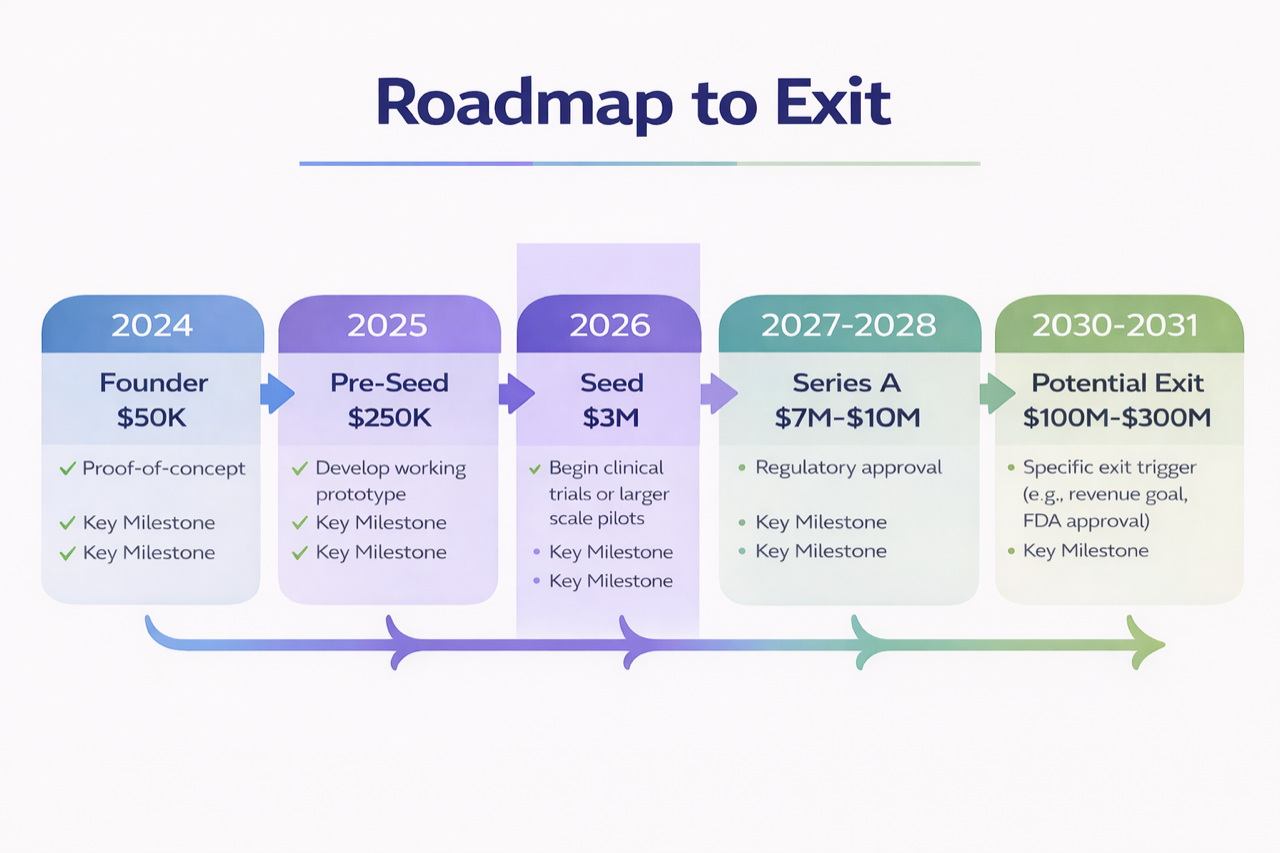
- Exit strategy — what triggers the exit (e.g., FDA clearance, a revenue level), how many more rounds and how large, comparable exits, and likely acquirers (see roadmap to exit graphic below).
- A clear ask — how much, cap or valuation, what milestones it buys, runway, and what success looks like.
Roadmap to exit
Medical Mondays prioritizes companies with a reasonable chance to exit in five years or less. We want to see the entire roadmap to exit on a single slide — the sequence of rounds, the capital raised at each, the milestone that unlocks the next step, and the exit trigger, timing, and likely acquirers at the end.
Use the format below as a reference for the slide we want to see:
Be ready to answer
A quick self-check before pitching. Companies that do well can answer these crisply:
- Who is your single closest competitor — including any emerging startup — and exactly why does a customer choose you over them?
- Who actually uses and pays for this, and what behavior has to change for adoption? What is the reimbursement or budget path?
- For devices/diagnostics: what clinical or real-world outcome evidence do you have, beyond bench data?
- For diagnostics: why does diagnosing change patient management here?
- For therapeutics: what is the endpoint, is the proof-of-principle real for that endpoint, and what is the time and path to the clinic?
- What is your round structure (preferred? capped? US entity? lead committed?), and what are the unit economics for the buyer and for you?
- What triggers your exit, who buys you, and what does the path of rounds to get there look like?